Can you introduce your research line?
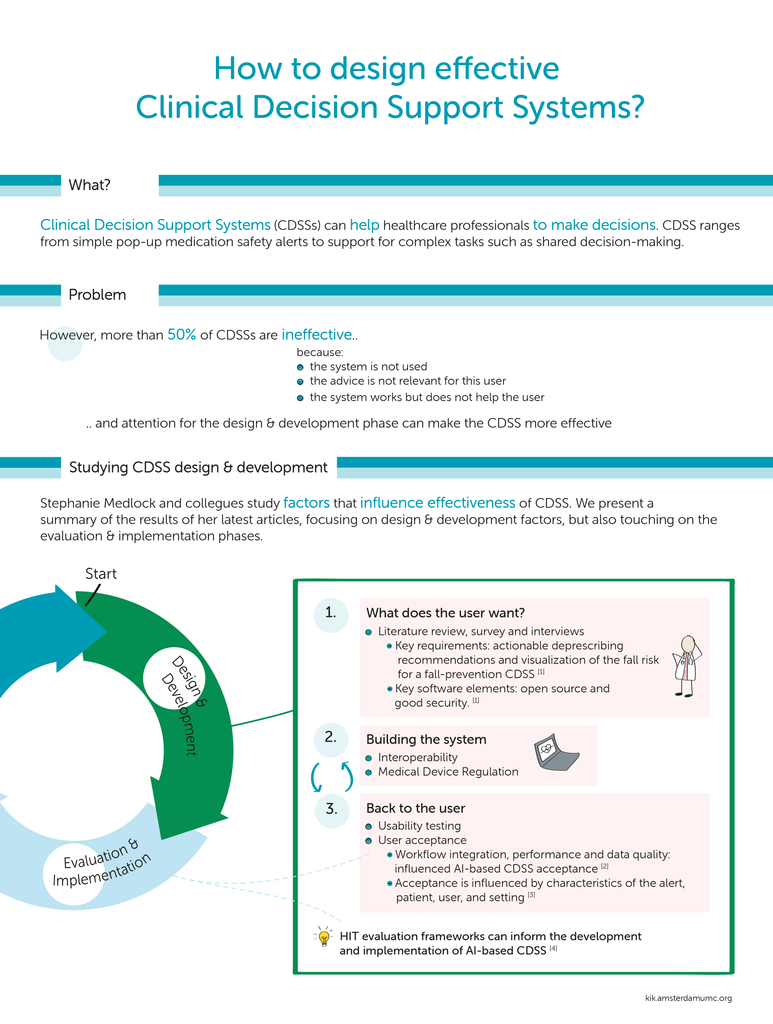
My research line is investigating effectiveness in Clinical Decision Support Systems. “Clinical Decision Support” includes all systems that support the user in making a health decision by providing advice about an individual patient. Thus, this includes both simple medication-safety alerts and more complex, interactive systems, and also sometimes systems that are used directly by the patient. “Effectiveness” means that the system is effective in achieving some goal – often an improvement in patient safety, but sometimes other outcomes such as reduced workload for the doctor or reduced decisional conflict for the patient.
Why do you focus on factors that influence CDSS effectiveness?
If we understand what makes a CDSS effective (or ineffective), we can design better systems in the future. It is almost impossible to imagine modern medicine without clinical decision support. Rule-based medication safety alerts are an essential pillar of patient safety. However, in practice, we know that 50-95% of alerts are overridden, and that most of these overrides are justifiable. We see similar numbers for more complex systems. Decision support interventions are complex interventions; if it works, it is often difficult to determine why it works, and vice versa. There is no simple “recipe” for a good CDSS. However, quantitative research on alert handling behavior can give us an indication of what “ingredients” are important, and qualitative research can give us insights into how those factors interact to influence user behavior, decisions, and ultimately patient outcomes.
What do you hope to achieve?
Ideally, I would like doctors to have CDSS tools that provide good support where it’s needed, and aren’t in the way. That means providing CDSS developers with evidence-based guidelines for system design, which means first building up the evidence base to write such guidelines.
Do you have tips for researchers who are using CDSS in their research?
Always start by understanding your future users, including how and when they interact with the computer and which decisions they might want supported. Keep getting user feedback throughout the design process.
These days, it is also important to understand the regulation around CDSS (MDR, AI Act, etc.) as these requirements need to be considered from the start.
If you can, design your study to learn not just if an intervention works but also gain insight into why it worked. This will help us build a knowledge base for the future.
What are your future plans?
In the short term, we plan to continue to explore quantitative analysis of alert data, to see if this might offer insights to reduce alert fatigue. We also plan to do some qualitative research to learn more about alert handling behavior and which alerts are perceived as useful, and why. We are also studying whether physicians draw correct conclusions from AI explanations, and whether the presentation of the explanation can help with that. In the longer term, I plan to look further into the outcomes we use to measure effectiveness, as well as working on setting up systems we can use to demonstrate innovative forms of CDSS.
Literature
[4] Evaluating Artificial Intelligence in Clinical Settings—Let Us Not Reinvent the Wheel