Can you introduce the ERA Registry and your research line?
Our research line focuses on international practice variation and outcomes for patients with kidney disease. We make use of large European renal registry databases as well as other observational standardized care data. One of these databases is the ERA Registry that includes data of (almost) all dialysis and kidney transplant patients from nearly all European countries.
Why did you conduct a target trial emulation for this research question?
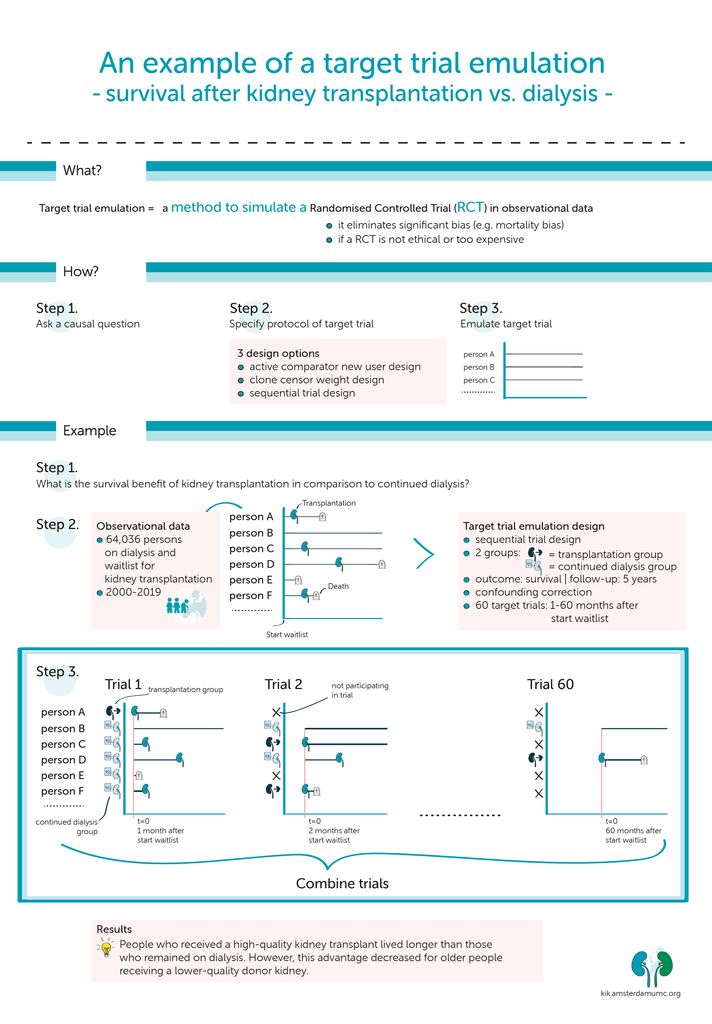
While a randomized controlled trial would be ideal to quantify the transplant survival benefit over dialysis, it is not ethical. Therefore, we rely on observational data, with target trial emulation aiming to simulate a randomized controlled trial and eliminate important time biases.
What were the main challenges in using target trial emulation?
Target trial emulation offers significant advantages to minimize bias when studying the effect of a therapy using observational data. Applying target trial emulation is however quite complex, because of study design challenges, observational data limitations and advanced analytical methods. It is also challenging to explain this method in a scientific paper.
Do you have tips for researchers who are planning to conduct a target trial emulation?
My main tip would be to include both experts on target trial emulation as well as clinical experts in the team, and let them work closely and effectively.
What are your future plans?
As a team, we continue focusing on causal inference, which in our case involves studying the effect of a therapy using observational data in the domain of kidney disease. Additionally, we are developing a European chronic kidney disease (CKD) Registry for patients with CKD who are not undergoing dialysis or kidney transplantation. This new database will gives us lots of opportunities for research.
Curious and want to read more?